Vitalik Buterin Dares AI to Unmask His Anonymous Writing

Ethereum's co-founder volunteered his own anonymous writing as bait in a public test of whether AI can strip the mask off pseudonymous crypto contributors.
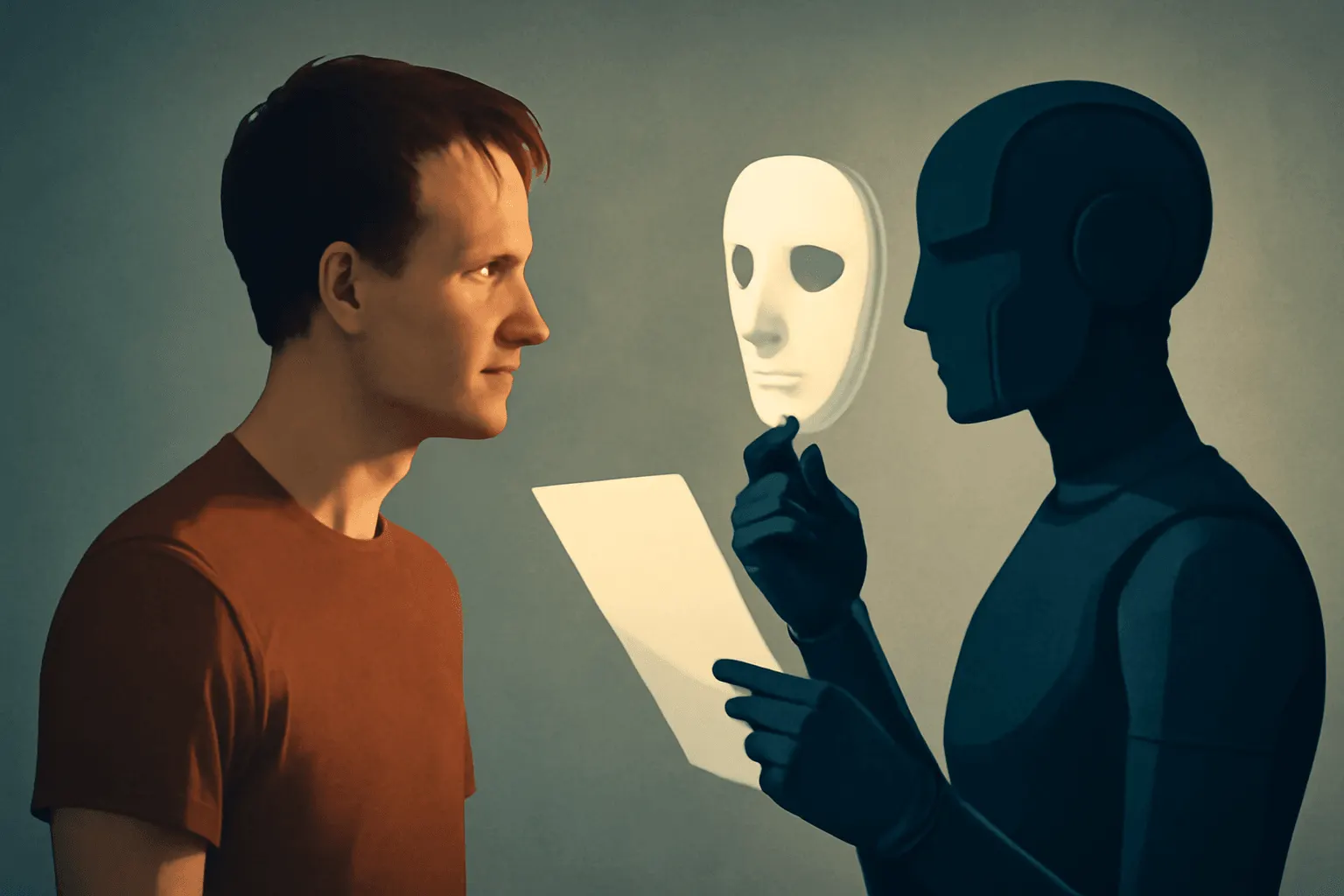
Buterin makes himself the experiment
Vitalik Buterin has a habit of turning abstract worries into live tests, and his latest stunt puts his own privacy on the line. As reported by crypto.news, the Ethereum co-founder issued a public challenge inviting both people and AI tools to identify an anonymous Ethereum-related document he says he wrote earlier this decade under a separate identity.
"So let me cannibalize a piece of my own anonymity to do an experiment," Buterin wrote when he launched the challenge. He offered a few breadcrumbs without giving the game away, describing the mystery text as being of "medium importance to Ethereum" and estimating that somewhere between 200 and 2,000 comparable documents exist. That framing hands would-be sleuths a haystack that is large but not infinite, which is precisely what makes the test meaningful.
The real subject is stylometry
The document itself is almost beside the point. According to crypto.news, the experiment is designed to probe a deeper question that has been gnawing at privacy-minded technologists: has stylometry, the analysis of writing patterns, word choice, sentence structure and other linguistic fingerprints, become powerful enough that modern AI can reliably deanonymize the person behind a pseudonymous post?
Stylometric analysis is not new. Researchers have used it for years to attribute disputed texts and flag ghostwriting. What has changed is scale and accessibility. Large language models can now ingest enormous bodies of writing and surface subtle patterns at a speed and cost that were unthinkable a few years ago, putting a capability that once required specialists into the hands of anyone with a chatbot.
The headline points from the challenge, per crypto.news:
- Buterin claims authorship of an anonymous Ethereum document written under an alternate identity.
- He has invited the public, and AI systems, to figure out which document it is.
- The aim is to gauge how exposed pseudonymous contributors really are.
- At the time of reporting, no confirmed correct identification had emerged.
Why this matters for Ethereum's culture
The stakes are cultural as much as technical. Ethereum has long leaned on pseudonymous contributors who publish research-still-winning-ai-talent-war), ship code and weigh in on governance without ever attaching their legal names. That tradition lets people participate based on the quality of their ideas rather than their identity, and it offers protection to contributors who have legitimate reasons to stay private. If an off-the-shelf model can reliably match an anonymous essay to a known author, that protective layer thins for everyone who relies on it.
There is a defensive logic to running the test in the open. By volunteering his own writing as bait, Buterin is effectively crowdsourcing a stress test rather than waiting for a hostile actor to attempt the same thing quietly. A clear result, in either direction, tells the community something useful: either online anonymity is more fragile than people assumed, or it is sturdier than the doomsayers fear.
Part of a broader privacy push
The challenge dovetails with the direction of Buterin's recent work, which has tilted heavily toward privacy, AI safety and the resilience of contributor anonymity within the Ethereum ecosystem. He has increasingly framed privacy not as a niche feature but as a precondition for a healthy decentralized community. Whether or not anyone cracks the puzzle, the exercise itself sends a message, and the eventual outcome could shape how the next generation of Ethereum researchers decides to publish their work.
Related on Ni4o: Buterin Pushes Ethereum Foundation to Cut Spending 40% · Michael Dell Becomes World's Fifth-Richest on AI Boom · Oracle Cuts 21,000 Jobs as Ellison Leans Into AI · OpenAI Eyes 2027 IPO as Altman Holds Firm on $1 Trillion
 ProfileVitalik ButerinCo-founder of Ethereum
Related

Nadella Bets on a 33-Year-Old Exec to Fix Copilot
Fortune reports that Satya Nadella is leaning on 33-year-old Jacob Andreou, now running Microsoft Copilot, to pull the company's flagship AI assistant ahead after a slow start.

PewDiePie's Odysseus Turns Local AI Into a Real Workspace
Odysseus, the free self-hosted AI workspace built by Felix 'PewDiePie' Kjellberg, has blown past 76,000 GitHub stars within a month, pitching a simple idea: own your AI instead of renting it.

Michael Dell Becomes World's Fifth-Richest on AI Boom
A 225% surge in Dell stock has pushed Michael Dell's fortune to roughly $216 billion, vaulting him to fifth on the global rich list as demand for AI servers explodes.